Why Trust AllQbanks? We help thousands of IMGs and Canadian medical students prepare for the MCCQE every year. Our study guides are verified against official MCC objectives and informed by proprietary performance data from our 5,200+ question testing platform. Read our Editorial Policy.
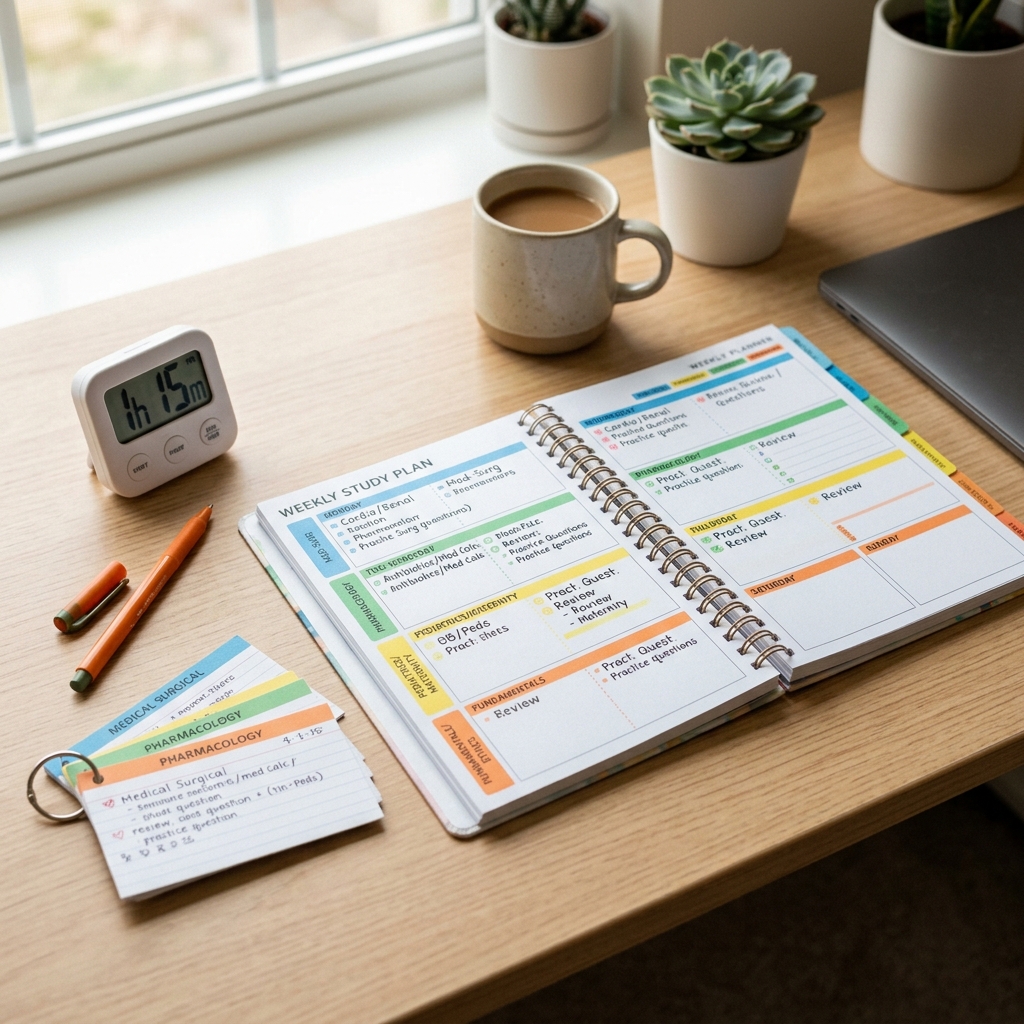
A study plan is the difference between passing the NCLEX on your first attempt and scrambling through unfocused review. This guide gives you two proven schedules — a 6-week intensive and an 8-week standard plan — with daily targets, weekly milestones, and clear readiness benchmarks.
Key Takeaways
- A 6-week plan works for students with strong nursing school foundations. An 8-week plan is better for students with content gaps.
- Aim for 4–6 hours per day, 5–6 days per week. Take one full rest day weekly.
- Spend 30% of your time on content review and 70% on practice questions.
- You're ready to test when you score 65%+ on a full-length CAT simulation consistently.
Before You Start: The Baseline Assessment
Before building your schedule, take a 75-question practice test that covers all 8 client needs categories. Your results will tell you:
- Which categories you're strong in (70%+ correct) — maintain with light practice
- Which categories need work (50–69% correct) — allocate heavy study time
- Which categories are critical gaps (below 50%) — prioritize these first
Take a full-length NCLEX practice test to establish your baseline. Don't study beforehand — you want an honest snapshot.
The 6-Week NCLEX Study Plan
This schedule assumes 5 hours per day, 6 days per week, with one rest day. Total study time: approximately 180 hours.
Week 1: Content Foundation (Heavy Review)
Daily schedule (5 hours):
- 3 hours: Content review of weakest 2–3 client needs categories
- 1.5 hours: 50 practice questions in those categories
- 30 minutes: Review all rationales (correct and incorrect answers)
Focus areas: Management of Care and Pharmacological Therapies — these two categories make up 29–41% of the exam. Start here.
Milestone: By Friday, you should be able to explain the ABC framework (Airway, Breathing, Circulation) and Maslow's Hierarchy without looking at notes.
Week 2: Content Foundation (Continued)
Daily schedule (5 hours):
- 2.5 hours: Content review of remaining client needs categories
- 2 hours: 75 practice questions (mixed categories)
- 30 minutes: Rationale review + flashcards for pharmacology
Focus areas: Physiological Adaptation, Safety and Infection Control, Reduction of Risk Potential.
Milestone: Complete your first pass through all 8 content categories. Your practice question accuracy should be improving in your initial weak areas.
Week 3: Active Practice Begins
Daily schedule (5 hours):
- 1 hour: Targeted content review on weakest area from Week 2
- 3 hours: 100 practice questions (mixed, all categories)
- 1 hour: Deep rationale review — write down the reasoning pattern for every wrong answer
Shift: From this week forward, questions drive your study. Content review becomes supplemental.
Milestone: Consistent 55%+ accuracy across all categories on timed practice.
Week 4: NGN Focus + Timed Blocks
Daily schedule (5 hours):
- 1 hour: NGN-specific practice (case studies, bow-tie, matrix, trend questions)
- 3 hours: 100 practice questions in 75-minute timed blocks
- 1 hour: Category performance analysis + targeted review
New element: Timed blocks (75 questions in 75 minutes). This trains pacing — about 60 seconds per question. On the real exam, you have slightly more time, but practicing at a faster pace builds a buffer.
For NGN-specific practice, use our NGN practice questions guide.
Milestone: Completing timed blocks without running out of time. Accuracy at 60%+ in timed conditions.
Week 5: Simulation + Weak Area Recovery
Daily schedule (5 hours):
- Take a full-length CAT simulation (Monday and Thursday)
- 2.5 hours: Practice questions focused exclusively on your bottom 2 categories
- 30 minutes: Pharmacology drug card review (top 50 NCLEX drugs)
Milestone: Scoring 60–65% on full-length simulated exams. If you're using Archer, aim for a "High" or "Very High" readiness score.
Week 6: Final Push + Test Readiness
Daily schedule (4 hours — reduce intensity):
- 2 hours: 75 mixed questions (light practice to maintain)
- 1 hour: Review commonly missed question types
- 1 hour: Test-day logistics (Pearson VUE tutorial, ID check, timing strategy)
- Rest the day before your exam. Light review only — no new content.
Readiness indicators:
- 65%+ on two consecutive full-length CAT simulations
- No category below 55%
- Comfortable with all 6 NGN question types
- Finishing timed blocks with time to spare
The 8-Week NCLEX Study Plan
This extends the 6-week plan for students who need more content review time. Key differences:
| Week | Focus | Hours/Day |
|---|---|---|
| 1–3 | Content review — spend 60% of time reviewing, 40% on questions | 5 |
| 4–5 | Transition — shift to 70% questions, 30% review | 5 |
| 6–7 | Simulation — full CAT simulations, NGN focus, weak area recovery | 5 |
| 8 | Taper — light practice, test-day prep, rest | 3–4 |
The 8-week plan adds 2 weeks of content foundation (Weeks 1–3) before entering the question-heavy phase. If your baseline score was below 50% in multiple categories, this is the safer schedule.
Daily Question Targets
Over a 6-week plan, you'll complete approximately 2,700 practice questions. This falls within the 1,500–3,000 range that most successful first-time passers report.
What to Do When Your Plan Falls Apart
Everyone misses days. The difference between passing and failing is how you recover:
- Missed 1 day: Add 30 minutes to the next 3 days. Don't try to cram a full day into one session.
- Missed 2–3 days: Skip the content review you missed. Do the questions instead — questions teach content faster than passive review.
- Missed a full week: Extend your plan by 5 days, not a full week. You retain more than you think.
- Burnout: Take 2 full rest days, then return at 70% intensity for 3 days before resuming full load. Studying while burnt out produces negative returns.
How to Know You're Ready to Test
Don't schedule your exam until you hit these benchmarks:
- 65%+ on two consecutive full-length CAT simulations (Archer "Very High" readiness or equivalent)
- No single category below 55% — one weak category can sink you if the algorithm focuses on it
- Comfortable with NGN case studies — you can work through a 6-question unfolding case without panicking
- Finishing timed blocks with time to spare — pacing anxiety is a real test-day problem
If you're not hitting these, postpone your exam date. An extra 2 weeks of focused prep is better than retaking the exam in 45 days.
Related NCLEX Resources
- NCLEX Study Guide — the complete prep roadmap
- NCLEX Practice Test — take your baseline or final simulation
- Best NCLEX Prep Courses — find the right QBank and study tools
- NCLEX-PN Study Guide — study plan adapted for LPN/LVN candidates
- Free NCLEX Practice Questions — start practicing today
Frequently Asked Questions
How many hours a day should I study for the NCLEX?
Four to six hours per day is the sweet spot. Below 4 hours and progress is too slow for a 6–8 week timeline. Above 6 hours and diminishing returns set in — your brain stops retaining new information effectively.
Should I study on weekends?
Study 5–6 days per week and take at least one full rest day. Most successful candidates study Monday through Saturday and rest Sunday. Consistency matters more than marathon sessions.
Is 4 weeks enough to study for the NCLEX?
Four weeks is tight but possible if you scored 65%+ on your baseline assessment and have no major content gaps. A 4-week plan requires 6+ hours per day and high discipline. Most candidates are better served by 6–8 weeks.
What if I keep scoring below 60% on practice tests?
If you've been studying for 3+ weeks and still score below 60%, you likely have content gaps that practice questions alone won't fix. Add a content review resource (Hurst, SimpleNursing, or Mark Klimek lectures) and spend 60% of your time on review for 1–2 weeks before returning to heavy practice.
Related Posts
 nclex
nclexNCLEX Study Guide: Everything You Need to Pass in 2026
2026 NCLEX study guide — exam format, April 2026 test plan, NGN question types, client needs categories, study timeline, and best prep resources.
AllQbanks Team •
Jul 31, 2026
![Next Generation NCLEX (NGN): Question Types Guide [2026]: feature image](/img/next-generation-nclex.png) nclex
nclexNext Generation NCLEX (NGN): Question Types Guide [2026]
Next Generation NCLEX (NGN) guide — the 6 new question types, Clinical Judgment Measurement Model, unfolding case studies, and how to prepare.
AllQbanks Team •
Jul 31, 2026