
Why Trust AllQbanks? We help thousands of IMGs and medical students prepare for the exams every year. Read our Editorial Policy.
Med School Bootcamp has the most realistic and accurate question bank for Step 1, based on the comparison to the actual exam with more than 2,500 questions. The questions were built to closely reflect the current pass/fail Step 1, including longer clinical stems, newer question formats, and direct NBME-style reasoning. Custom tests provide longer practice sessions, while Daily Warmup offers a shorter starting point. Previous Tests, Review Session, and performance tools help organize follow-up work after a study session.
For M1 and M2 students who prefer video teaching, that makes Bootcamp a useful option for both coursework and USMLE Step 1 preparation. This review covers its subjects, learning tools, pricing, and how it compares with UWorld and the other options in our Step 1 QBank comparison.
Key Takeaways
- The Step 1 curriculum is organized into 19 subject areas, with videos, recall practice, and a board-style QBank.
- Bootcamp lists 2,500+ Step 1 questions. The Cardiology module includes 360 questions and 347 lessons, with 21 hours and 9 minutes of video content.
- Plans cost $79 monthly, $299 for one year, or $449 for two years, as listed in September 2026.
- Anatomy Bootcamp, performance tracking, a schedule creator, and Ask Bootcamp AI round out the package.
- A three-day trial lets you explore the platform without a credit card. The pass guarantee has separate eligibility requirements.
Med School Bootcamp at a Glance
| Feature | Details |
|---|---|
| Best fit | Medical students who want video teaching and Step 1 practice together |
| Step 1 subjects | 19 areas covering foundational sciences and organ systems |
| Step 1 QBank | 2,500+ board-style questions |
| Video lessons | Organized by subject and topic |
| Bites | Recall quizzes connected to lessons |
| Study tools | Custom tests, Daily Warmup, Review Session, performance tracking, and a schedule creator |
| Flashcards | AnKing v12 integration; separate deck access may be required |
| Additional resources | Anatomy Bootcamp and Step 2 content labeled Preview |
| Access | Browser and mobile app |
| Free trial | Three days without a credit card |
Subjects, Modules, and Course Content
Med School Bootcamp divides its Step 1 curriculum into 19 subject areas. The menu combines foundational sciences, such as biochemistry and genetics, with organ systems, such as cardiology and neurology. This organization makes it straightforward to follow a school block or return to a subject that needs more review.
| Subject group | Modules |
|---|---|
| Foundational sciences | Biochemistry, Biostatistics, Genetics, Immunology, Microbiology, Pathology (Principles), Pharmacology (Principles), Public Health Sciences |
| Organ systems and clinical subjects | Cardiology, Dermatology, Endocrinology, Gastroenterology, Hematology & Oncology, Musculoskeletal, Nephrology, Neurology, Psychiatry, Pulmonology, Reproduction |
Cardiology, for example, contains 360 QBank questions and 347 video lessons, with a listed runtime of 21 hours and 9 minutes. Its three main tabs are Step 1 QBank, Cardiology Videos, and Cardio Bites. Videos are grouped by topic, while Bites provide shorter recall practice alongside the teaching content. These figures describe Cardiology specifically; they are not the course-wide totals.
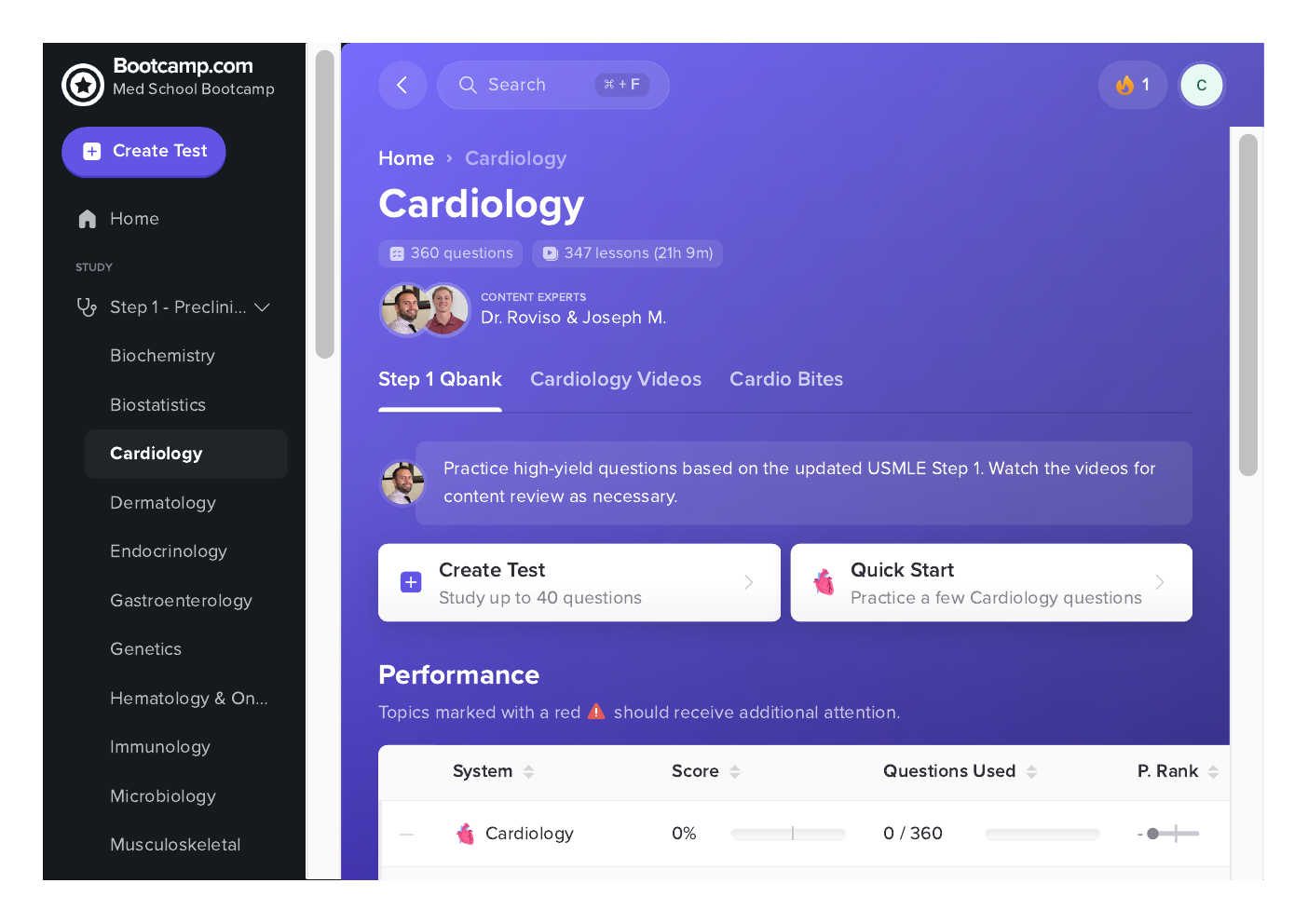
Each subject card tracks questions used and lessons completed. Within the Cardiology QBank, the performance table breaks results down into anatomy, pathology, pharmacology, and physiology. A separate time-management view compares your pace with the average time per question so you can distinguish content problems from pacing problems.
Video Lessons, Bites, and AnKing Integration
Bootcamp's learning sequence works well for students who want to watch, recall, then apply. Start with a video on the topic you are studying, use Bites to check the details you remember, and move to board-style questions to practice applying those ideas in a vignette.
During preclinical coursework, this gives each study session a clear structure. During dedicated preparation, you can use the videos selectively: revisit a concept after missing a question, then return to practice instead of restarting an entire subject.
The AnKing v12 integration connects Bootcamp content with spaced-repetition study. Students already using AnKing can bring relevant flashcards into their review routine. Check the deck and AnkiHub access requirements separately when calculating the cost of your study resources.
Ask Bootcamp AI adds a way to ask follow-up questions about confusing material. Use the source lesson and question explanation as your reference when checking an AI-generated answer.
Step 1 QBank and Practice Features
Bootcamp lists more than 2,500 Step 1 questions with explanations and video support. Custom tests provide longer practice sessions, while Daily Warmup offers a shorter starting point. Previous Tests, Review Session, and performance tools help organize follow-up work after a study session.
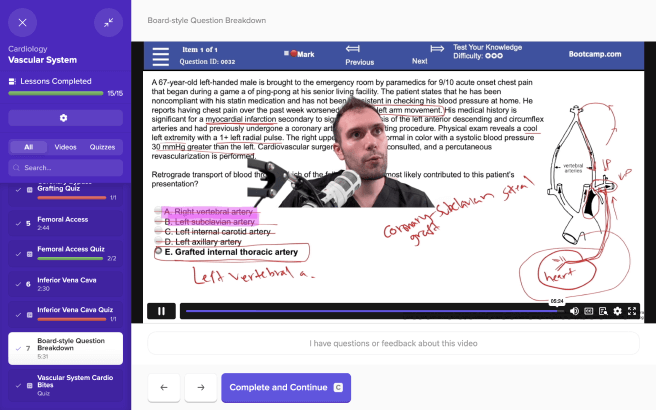
The Cardiology page includes a Create Test option for up to 40 questions and a Quick Start option for a few subject-specific questions. Performance tables show scores, questions used, and percentile rank; time-management information adds context about pacing.
For exam-day preparation, match your practice schedule to the current USMLE Step 1 format and leave time for official assessments. Question-bank percentages are useful for tracking learning, but they should not be treated as a guaranteed exam result.
Performance Tracking and Pass Targets
The performance dashboard combines overall accuracy, QBank usage, percentile rank, and system-level results. It also displays progress toward Bootcamp's Pass Targets, so you can see both question completion and performance in one place.
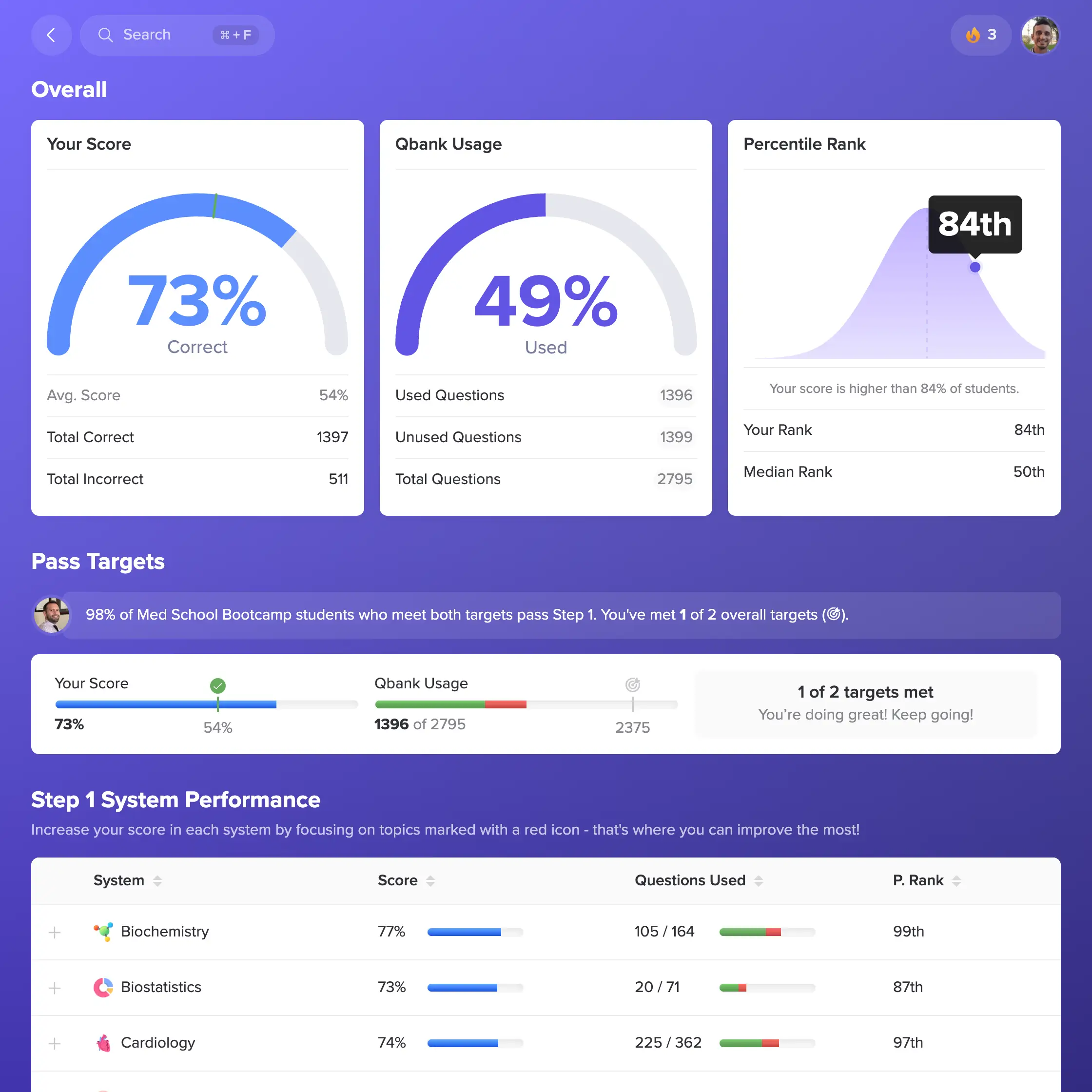
System rows make it easier to identify where review time is needed. Use the scores alongside questions used: a strong percentage from a small sample provides less information than consistent performance across a larger set. Pass Targets are Bootcamp's own indicators; official assessments and your school's guidance remain useful for planning exam readiness.
Study Schedule and Additional Resources
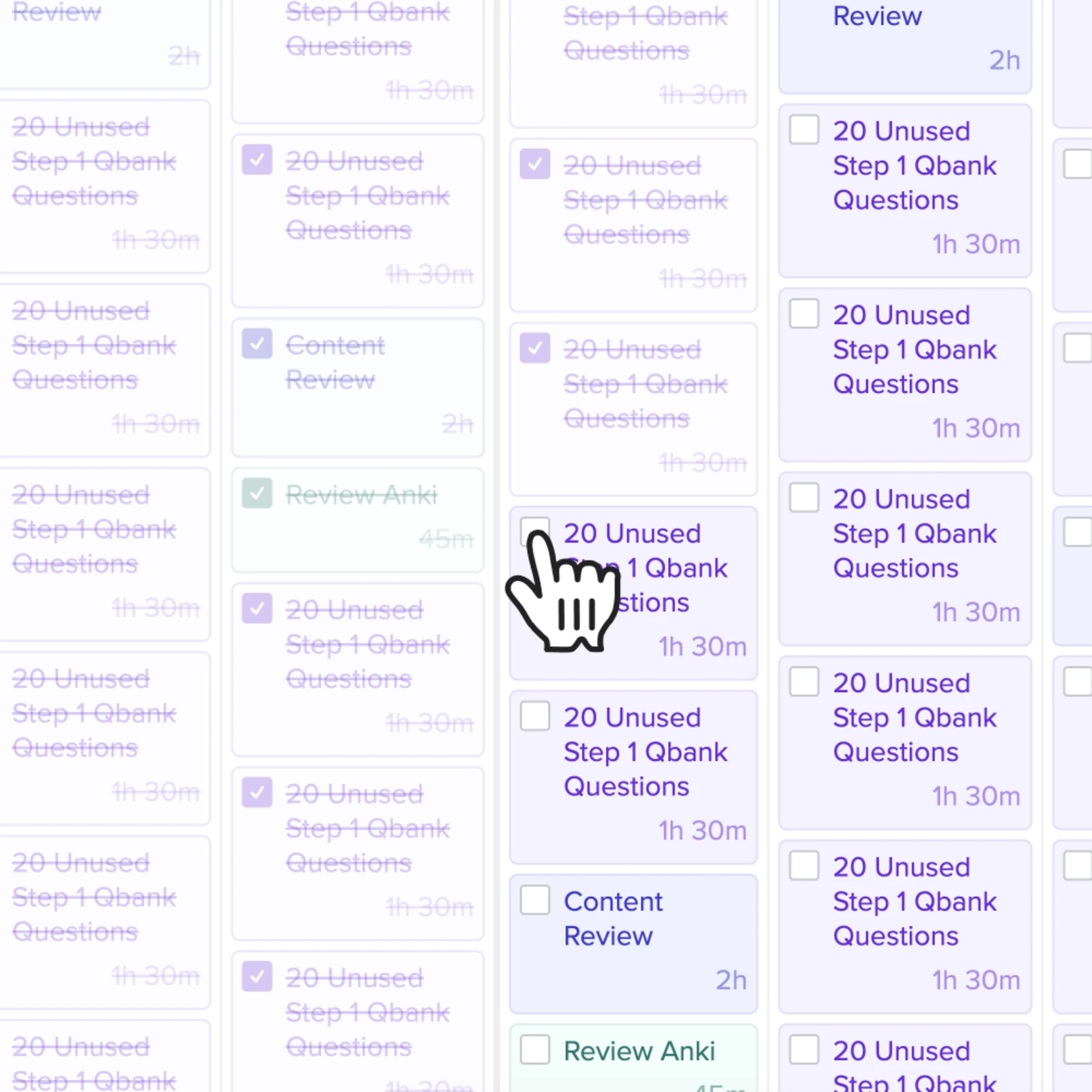
The Study Schedule creator organizes preparation around an exam date and offers QBank-focused and full-review schedules. A QBank-focused schedule suits students who are ready for practice, while a full-review approach adds more content study. Build in time to review missed questions and complete your school's required assessments.
Bootcamp also includes Anatomy Bootcamp with its Med School plans. This adds anatomy resources alongside the Step 1 curriculum. The pricing page labels Step 2 content as Preview, so students planning ahead for clinical exams should check the available coverage before relying on it for Step 2 preparation.
Mobile access lets you continue studying away from your desk. The most useful arrangement will depend on the task: short recall sessions fit a mobile routine, while longer question blocks are easier to organize around a dedicated study period.
Med School Bootcamp Pricing in 2026
Bootcamp's September 25, 2026 pricing lists $79 for one month, $299 for one year, and $449 for two years. The longer plans make more sense when you intend to use both the teaching library and question bank throughout medical school coursework.
| Plan | Price in USD | Best suited to |
|---|---|---|
| Monthly | $79 | A short review period or a final month of preparation |
| One year | $299 | Coursework followed by Step 1 preparation |
| Two years | $449 | A longer study window across preclinical training |
The three-day full-access trial does not require a credit card. Use it to explore a subject you are currently studying, watch a lesson, try its Bites, and review a QBank explanation. Confirm current prices and checkout terms before purchasing, since offers can change.
How the Pass Guarantee Works
The pass guarantee applies to qualifying one- and two-year memberships purchased at least 30 days before the exam. Bootcamp's terms require students to meet both Pass Targets before test day, provide proof of a failed result, and meet its accredited US or Canadian school requirement. The monthly plan is not listed as eligible. Review the current terms to see whether you qualify.
Med School Bootcamp vs UWorld and Amboss
Bootcamp's main distinction is the combination of video teaching, recall quizzes, and question practice. UWorld Step 1 centers on question practice and detailed explanations, while Amboss combines a QBank with a medical reference library.
| Your study priority | Resource to consider |
|---|---|
| Learn or rebuild concepts with videos, then practice | Med School Bootcamp |
| Build dedicated study around question review | UWorld |
| Look up medical concepts while working through questions | Amboss |
If your school already provides a QBank, consider which part of Bootcamp you would use regularly. Its videos and Bites can complement an existing question routine, but adding another subscription makes the most sense when it addresses a specific gap.
Pros and Cons
| Strengths | Trade-offs |
|---|---|
| Videos, recall quizzes, and a Step 1 QBank in one subscription | Students seeking only extra questions may use less of the teaching library |
| 19 subject areas with topic-based organization | A large content library requires a realistic study schedule |
| Anatomy resources and schedule creator included | AnKing integration may involve separate deck access |
| Three-day trial without a credit card | Pass guarantee eligibility is restricted to qualifying longer plans |
Is Med School Bootcamp Worth It?
Med School Bootcamp is a strong option for students who want structured video review and Step 1 practice together. The combination is particularly relevant to M1 and M2 students following system blocks, or students entering dedicated study with concepts they need to revisit.
At the listed $299 annual price, its value comes from using several parts of the package consistently. If you prefer reading and already have a question bank, the additional video library may be less useful. Try a subject during the free trial and decide whether the teaching format fits the way you study.
Frequently Asked Questions
How many questions does Med School Bootcamp have?
Bootcamp lists 2,500+ board-style Step 1 questions. The curriculum is organized into 19 subject areas. Cardiology includes 360 questions and 347 video lessons; other subjects have their own question and lesson counts. Bites are a separate recall activity alongside the teaching content.
Is Med School Bootcamp enough for Step 1?
Bootcamp combines content teaching, recall practice, and a Step 1 QBank to address the main parts of Step 1 preparation. Use official assessments and your school's guidance to check readiness. If those assessments reveal a persistent weakness, add focused review in that area rather than measuring readiness by course completion alone.
Does Med School Bootcamp include anatomy?
Yes. Anatomy Bootcamp is included with the Med School plans described on the pricing page. It supplements the Step 1 curriculum with anatomy resources. Step 2 material is separately labeled Preview, so check that coverage if you also want a resource for clinical exam preparation.
Is Bootcamp better than UWorld for Step 1?
Bootcamp suits students who want video teaching and recall quizzes alongside question practice. UWorld suits students who want to build their routine around a QBank and detailed explanations. Choose according to your content gaps, preferred teaching format, and the resources your school already provides.
Sources
Course features and pricing: Bootcamp's Med School product and pricing pages. Subject organization and module details: the Med School dashboard and Cardiology QBank, videos, and Bites sections. Information checked September 25, 2026. Exam guidance: USMLE Step 1.
Related Posts
 featurestutorials
MCCQE Custom Exam Builder 2026: Target Weak Clinical Areas
Build custom MCCQE Part 1 practice exams from 5,200+ MCQs. Target weak CanMEDS roles, track performance data, and master test-day timing.
Dr. Leila Haddad •
Jan 28, 2026
![Mental Dental Review: How to Use Dr. Ryan's Video Series for the INBDE [2026]: feature image](/img/mental-dental-inbde-review.png) inbde
inbdeMental Dental Review: How to Use Dr. Ryan's Video Series for the INBDE [2026]
Review of Mental Dental by Dr. Ryan for INBDE prep: 56+ video playlists, subject breakdowns, Patreon study guides, and how to combine it with question banks.
AllQbanks Team •
Aug 18, 2026