Why Trust AllQbanks? We help thousands of IMGs and Canadian medical students prepare for the MCCQE every year. Our study guides are verified against official MCC objectives and informed by proprietary performance data from our 5,200+ question testing platform. Read our Editorial Policy.
Creating a disciplined USMLE Step 1 study plan is the single most effective way to manage study stress and ensure complete coverage of basic science disciplines (USMLE Bulletin, 2026). This guide provides a 6-month preparation roadmap followed by an intensive 6-week dedicated schedule.
Key Takeaways
- Divide your prep into a Pre-Dedicated Phase (learning systems alongside coursework) and a Dedicated Phase (4–8 weeks of intensive QBank practice and self-assessments).
- Aim to complete 100% of a primary QBank with thorough explanation reviews.
- Schedule NBME self-assessments every 1–2 weeks during dedicated prep to monitor passing probability.
How to Structure the 6-Month Pre-Dedicated Phase?
During months 1 through 4, your primary goal is building foundational knowledge alongside medical school organ system modules:
- Daily Goal: 20–40 organ-system specific QBank questions per day.
- Resource Integration: Annotate First Aid or digital flashcards while studying coursework.
- Focus Areas: Ensure solid retention in high-yield disciplines like Pathology, Physiology, and Pharmacology.
For subject-specific high-yield outlines, refer to our USMLE Step 1 High Yield Topics Breakdown.
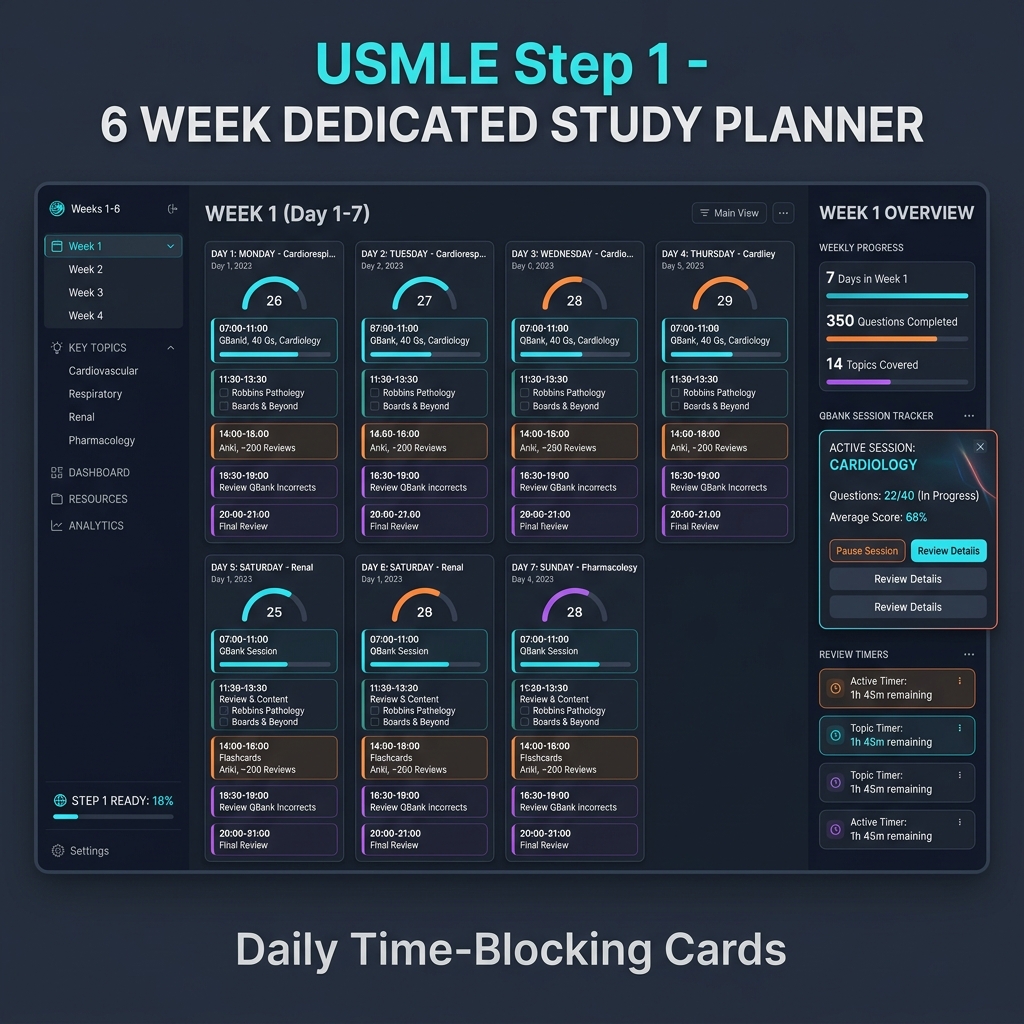
How to Time-Block Your 6-Week Dedicated Schedule?
During dedicated study (typically 4 to 8 weeks), your schedule shifts to full-time exam simulation:
Sample Daily Time-Blocking Schedule
- 8:00 AM – 10:00 AM: Block 1 — Timed, mixed 40-question QBank set.
- 10:00 AM – 12:30 PM: Deep review of Block 1 (reviewing both correct and incorrect answer choices).
- 12:30 PM – 1:30 PM: Lunch and mental break.
- 1:30 PM – 3:30 PM: Block 2 — Timed, mixed 40-question QBank set.
- 3:30 PM – 6:00 PM: Deep review of Block 2.
- 6:00 PM – 7:30 PM: Targeted weakness review (Pharmacology flashcards or Biochemistry pathways).
To evaluate question bank options for your dedicated schedule, see our comparison of the Best USMLE Step 1 Qbanks & Prep Courses.
How to Benchmarking Progress with Practice Exams?
Track your trajectory by integrating official NBME forms into your schedule:
- Baseline (Week 1): Take NBME Form 25 or 26.
- Mid-Dedicated (Week 3 & 4): Take NBME Forms 27, 28, or 29.
- Final Stretch (Week 5 & 6): Take NBME Form 30 or 31, followed by the official Free 120 at a Prometric center or home environment 3–5 days before test day.
For detailed score conversion tables and passing probability ranges, check out our guide on NBME Self-Assessments & Free 120 Score Conversion and practice with USMLE Step 1 Practice Questions.
What Is the Most Effective Dedicated Review Strategy?
Avoid the temptation to take a practice exam every 2 days. Self-assessments measure learning; QBank review produces learning. Allocate 3 to 4 days of thorough review and weak-point remediation between each NBME test.
For an overview of overall exam rules and pass rate statistics, see our master USMLE Step 1 Guide and our review of USMLE Step 1 Pass Rates.
Related Posts
![USMLE Step 1 Registration & Exam Cost Guide [2026]: feature image](/img/usmle-step-1-registration.png) usmle
usmleUSMLE Step 1 Registration & Exam Cost Guide [2026]
Step-by-step 2026 USMLE Step 1 registration guide covering $690 base exam costs, ECFMG permits, and Prometric test center scheduling rules.
Dr. Leila Haddad •
Jul 28, 2026
![Should You Use UWorld for MCCQE? UWorld vs AllQbanks [2026]: feature image](/img/UWorld-vs-AllQbanks.webp) featuresresources
featuresresourcesShould You Use UWorld for MCCQE? UWorld vs AllQbanks [2026]
UWorld has 0% Canadian content. That means 0 MAID questions, 0 CanMEDS questions, 0 Canadian screening guidelines. Here is when UWorld makes sense for.
Dr. Leila Haddad •
Feb 3, 2026