Why Trust AllQbanks? We help thousands of IMGs and Canadian medical students prepare for the MCCQE every year. Our study guides are verified against official MCC objectives and informed by proprietary performance data from our 5,200+ question testing platform. Read our Editorial Policy.
Many students open their assigned organic chemistry textbook during the first week of class, see a 1,300-page tome packed with microscopic diagrams and technical descriptions, and immediately feel overwhelmed. Standard textbooks often read more like academic reference manuals than teaching guides.
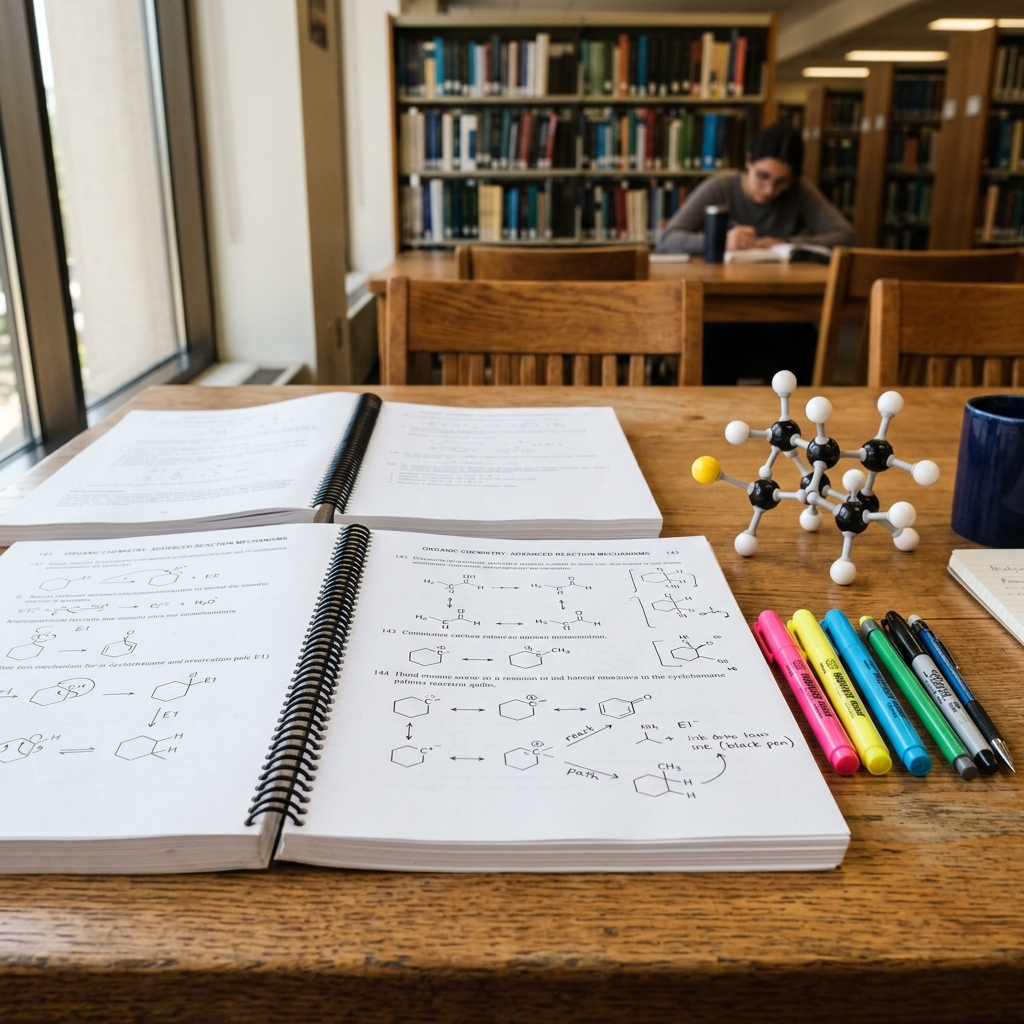
Dr. David Klein, a chemistry professor at Johns Hopkins University, recognized this disconnect. In response, he wrote Organic Chemistry as a Second Language. Published by Wiley, this two-volume workbook series (First Semester Topics and Second Semester Topics) has become one of the most widely recommended supplements in undergraduate science education.
In this comprehensive 2026 review, we analyze how David Klein's workbooks approach organic chemistry, evaluate their scaffolded exercise design and arrow-pushing instruction, assess pricing, and examine how to pair these books alongside Chad's Prep, Master Organic Chemistry, and Pearson+ Chemistry.
Key Takeaways
- Core Philosophy: Treats organic chemistry like a language with distinct grammatical rules (formal charges, resonance, electronegativity, sterics) that must be practiced through active writing.
- Scaffolded Problem Design: Each section presents a clear rule, walks through an annotated example, provides a guided problem with hints, and finishes with unassisted practice exercises.
- Two-Volume Coverage: First Semester Topics focuses on structure, resonance, acid-base, stereochemistry, substitution, and addition reactions; Second Semester Topics covers aromatics, carbonyls, enolates, and spectroscopy.
- Arrow-Pushing Fluency: Builds exceptional confidence in drawing curved electron arrows correctly, preventing random guessing on synthesis mechanisms.
- Affordable Ownership: One-time purchase of approximately $45 to $65 per book, with no recurring monthly subscriptions or digital paywalls.
- Best Use Case: Foundational skill development, active homework practice, and exam preparation for students who learn best by writing out problems.
Why David Klein's Approach Works
Most students who struggle in organic chemistry do not fail because they cannot memorize reaction names. They fail because they never developed fluency in the fundamental visual rules of molecular structures.
Klein's insight is that organic chemistry requires a specific skill set:
- Translating chemical formulas into bond-line structures without dropping carbons or implicit hydrogens.
- Drawing valid resonance structures without violating the octet rule or placing impossible formal charges on electronegative atoms.
- Visualizing molecules in three dimensions using dash-wedge notation, Newman projections, and chair conformations.
- Identifying electron-rich nucleophiles and electron-poor electrophiles to predict where curved arrows must begin and end.
Rather than jumping directly into multi-step reactions, Klein's First Semester Topics spends its first five chapters drilling these basic mechanics. By the time students reach substitution and elimination reactions (SN1, SN2, E1, E2), the mechanisms feel like logical extensions of basic electrostatic rules rather than arbitrary facts.
Detailed Breakdown: First Semester vs Second Semester Topics
1. First Semester Topics
The first volume is the most essential book in the series. It covers the foundational core of Organic Chemistry I:
- Chapter 1: Bond-Line Structures: Converting between Lewis, condensed, and skeletal drawings; reading implicit hydrogens and lone pairs.
- Chapter 2: Resonance: The golden rules of resonance, curved-arrow patterns (allylic lone pairs, carbocations, electronegative atoms), and assessing major versus minor contributors.
- Chapter 3: Acid-Base Reactions: Comparing acid strengths using ARIO (Atom, Resonance, Induction, Orbital) rather than memorizing pKa tables blindly.
- Chapter 4: Geometry & Conformations: Newman projections along carbon-carbon bonds, torsional strain, steric hindrance, and drawing cyclohexane chair flips with axial and equatorial substituents.
- Chapter 5: Configurations (Stereochemistry): Identifying chiral centers, assigning R and S priority configurations using Cahn-Ingold-Prelog rules, and distinguishing enantiomers, diastereomers, and meso compounds.
- Chapters 6 to 8: Reactions, Mechanisms, and Substitutions: Transition states, intermediates, SN2 versus SN1, and E2 versus E1 competition matrices.
- Chapters 9 to 11: Addition Reactions: Alkene and alkyne additions, regiochemistry (Markovnikov vs anti-Markovnikov), and stereochemistry (syn vs anti additions).
2. Second Semester Topics
The second volume addresses the heavier functional group transformations taught in Organic Chemistry II:
- Spectroscopy: Interpreting IR spectra for functional group peaks, analyzing 1H-NMR chemical shifts, integration, and spin-spin splitting (n+1 rule).
- Aromaticity & EAS: Determining aromatic, anti-aromatic, and non-aromatic molecules; understanding activating versus deactivating groups and ortho/para versus meta directors.
- Carbonyl Chemistry: Nucleophilic additions to aldehydes and ketones; protecting groups (acetals and ketals); Grignard reagents and carbanion additions.
- Carboxylic Acid Derivatives: Nucleophilic acyl substitutions across acid chlorides, anhydrides, esters, and amides, emphasizing the tetrahedral intermediate.
- Enolates & Condensations: Alpha-proton acidity, kinetic versus thermodynamic enolates, aldol reactions, Claisen condensations, Michael additions, and retrosynthetic analysis.
The Scaffolded Learning Structure
What sets Klein apart from standard textbooks is the pedagogical structure of each section:
- The Concept Explanation: Klein introduces a specific rule or pattern in three to four concise paragraphs, using plain language without excessive jargon.
- The Worked Example: A representative problem is broken down step by step, featuring an explicit "internal monologue" that shows how an expert chemist thinks through the problem.
- The Guided Practice Question: A similar problem is provided with structured hints and partial drawings to help the student apply the method.
- Unassisted Practice Problems: Three to eight additional problems with space to draw structures directly on the page, forcing independent problem solving.
- Detailed Solutions: Complete answers with fully drawn structures and curved arrows appear at the end of each section for immediate self-correction.
This feedback loop ensures that you never spend hours practicing a concept incorrectly.
Pricing & Format Options
Organic Chemistry as a Second Language is published by Wiley and is available in multiple formats:
- Physical Paperback: Typically $45 to $65 per volume on major book retail platforms or campus bookstores.
- Digital E-Book (VitalSource, Kindle, or Wiley): Rental options range from $25 to $40 per semester, with permanent digital purchases around $50.
- Resale Value: Because university chemistry curricula change very little from year to year, physical copies maintain excellent resale value among subsequent student cohorts.
Unlike subscription platforms that charge recurring monthly fees, purchasing Klein's workbooks represents a one-time investment for the entire academic year.
How Klein Compares to Competitors
Here is how David Klein's workbooks fit into the study toolkit compared to other resources in our Best Chemistry Study Tools review:
- Klein vs Chad's Prep: Chad's Prep is a comprehensive video lecture course. Klein's workbooks provide written, pen-and-paper practice. The ideal strategy is to watch Chad's video lessons for conceptual understanding and then complete Klein's exercises to lock in the muscle memory of drawing mechanisms.
- Klein vs Master Organic Chemistry: Master Organic Chemistry is an encyclopedic online reference tool with an exhaustive 185+ reaction database and reagent cheat sheets. Klein is a focused skill-building workbook that teaches you how to push arrows and analyze stereochemistry.
- Klein vs Pearson+ Chemistry: Pearson+ Chemistry provides video walkthroughs organized around commercial textbooks. Klein is independent of any textbook and focuses on core principles that apply to any university course.
How to Get the Most Out of Klein's Workbooks
To maximize your performance using Organic Chemistry as a Second Language:
- Read Ahead Before the Semester: Work through Chapters 1, 2, and 3 of First Semester Topics during the week before classes begin. Mastering bond-line drawings and resonance early eliminates 80 percent of early-semester confusion.
- Always Draw with a Pencil: Never just read the solutions. Physical repetition of drawing curved arrows, lone pairs, and chair conformations is what builds exam-day speed.
- Redo Missed Problems After 48 Hours: When you miss an exercise, mark it, review the solution, and return to it two days later to solve it from a blank page.
- Use as a Synthesis Bridge: Before attempting your professor's complex multi-step synthesis homework, complete Klein's synthesis sections to practice working backwards (retrosynthesis).
Frequently Asked Questions
Can Organic Chemistry as a Second Language replace my assigned college textbook?
Not entirely. Klein's workbooks do not contain comprehensive end-of-chapter reading or laboratory procedures. However, most students find that reading Klein teaches them the material much faster than their official textbook, making the textbook useful mainly for assigned homework numbers.
Should I buy both First Semester Topics and Second Semester Topics at the same time?
If you are enrolled in a standard two-semester Organic Chemistry sequence, you will need both books eventually. However, it is fine to purchase First Semester Topics first, as it contains all the fundamental stereochemistry, resonance, and substitution concepts needed for the first half of the course.
Are older editions of Klein's workbooks still useful?
Yes. The foundational principles of organic chemistry do not change between editions. A 3rd, 4th, or 5th edition provides virtually the same high-yield explanations and practice problems as the newest edition, often at a significant discount.
Final Verdict
Organic Chemistry as a Second Language by David Klein is the gold standard skill-building workbook for undergraduate organic chemistry students. Its scaffolded practice exercises, clear explanations of resonance and acid-base logic, and focused arrow-pushing drills make it an indispensable resource for mastering semester exams.
Review our comprehensive guide to the Best Chemistry Study Tools to see how Klein compares to other top resources, or explore our full collection of college chemistry reviews and study guides.
Related Posts
![OAT Destroyer Review: Dr. Romano's Problem Books and Physics Drills [2026]: feature image](/img/oat-destroyer-review.png) oat
oatOAT Destroyer Review: Dr. Romano's Problem Books and Physics Drills [2026]
In-depth OAT Destroyer review for 2026: Dr. Jim Romano's physical books, OAT Physics Destroyer, problem difficulty, study strategies, and pricing.
AllQbanks Team •
Sep 1, 2026
![How to Pass MCCQE Part 1 on Your First Try: 10 Tips [2026]: feature image](/img/pass-mccqe-first-attempt.webp) mccqetips
mccqetipsHow to Pass MCCQE Part 1 on Your First Try: 10 Tips [2026]
94% of CMGs pass the MCCQE first time. Only 58% of IMGs do. These 10 strategies close the gap: pacing, Canadian content front-loading, full simulations,.
Dr. Leila Haddad •
Feb 18, 2026