Why Trust AllQbanks? We help thousands of IMGs and Canadian medical students prepare for the MCCQE every year. Our study guides are verified against official MCC objectives and informed by proprietary performance data from our 5,200+ question testing platform. Read our Editorial Policy.
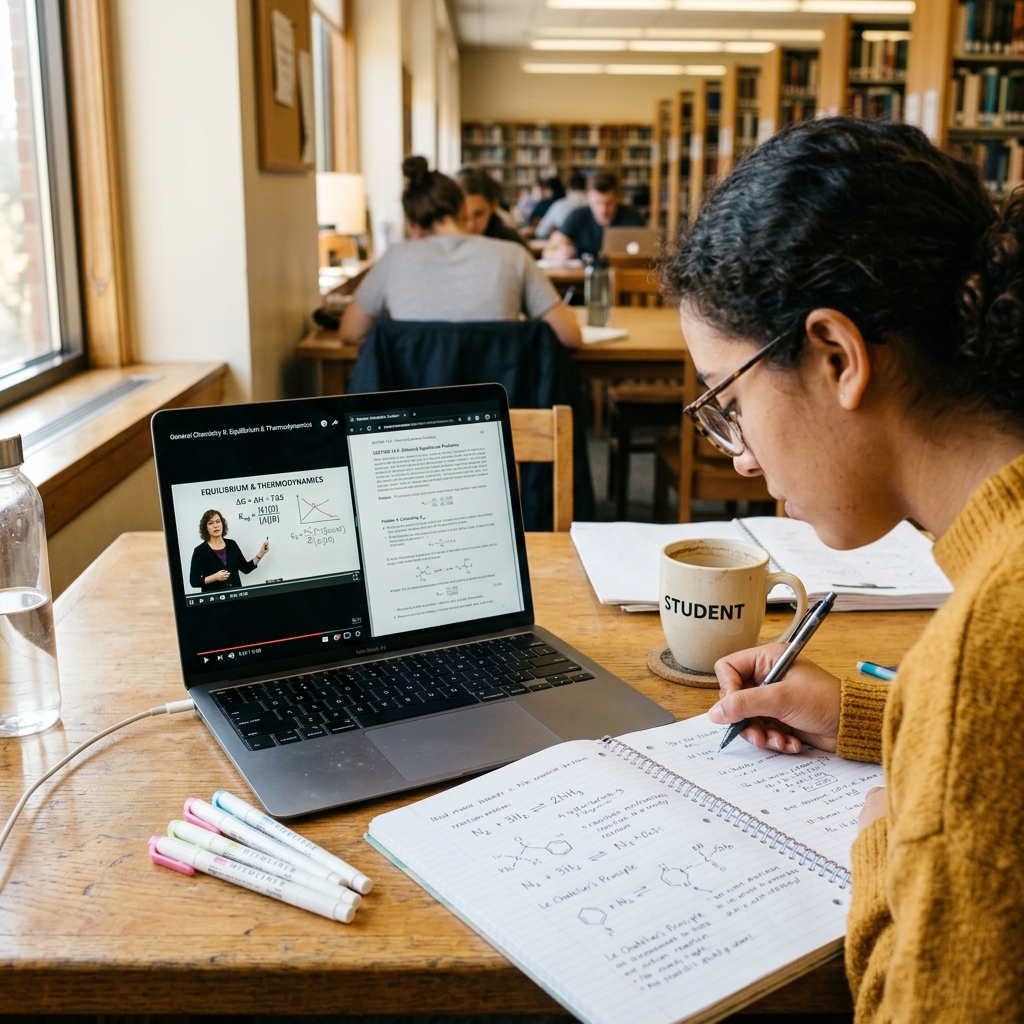
One of the most persistent challenges college chemistry students face is the gap between abstract lecture theory and specific textbook homework assignments. A professor might spend 50 minutes deriving thermodynamic equations on a whiteboard, but when students open their assigned problem set that evening, they encounter multi-part stoichiometry, buffer equilibrium, or retrosynthesis problems that look completely different from the lecture examples.
To bridge this gap, Pearson acquired Clutch Prep and integrated its course-specific video library into Pearson+ Channels. Today, Pearson+ Chemistry provides on-demand video explanations and practice problem walkthroughs indexed directly to the chapters of major commercial college chemistry textbooks.
In this detailed 2026 review, we analyze Pearson+ Chemistry, evaluate its textbook-aligned study channels for General Chemistry and Organic Chemistry, assess video solution quality and subscription pricing, and explain how to pair Pearson+ with Chad's Prep, Master Organic Chemistry, and Organic Chemistry as a Second Language.
Key Takeaways
- Textbook-Aligned Organization: Videos and practice questions are mapped directly to your specific university textbook and chapter syllabus, ensuring that what you watch directly matches your homework.
- Comprehensive Chemistry Coverage: Dedicated study channels cover General Chemistry I and II, Organic Chemistry I and II, as well as Physics and Calculus.
- Step-by-Step Problem Walkthroughs: Instructors demonstrate how to solve typical textbook problems on screen, walking through unit conversions, ICE tables, and reaction mechanisms.
- Bite-Sized Video Format: Concise 5 to 15 minute video segments make it easy to find explanations for specific homework questions without wading through long lectures.
- Subscription Pricing: Channels access costs approximately $9.99 to $14.99 per month, making it an affordable monthly add-on for students already using Pearson eTextbooks.
- Best Use Case: Homework assistance, textbook problem problem-solving walkthroughs, and targeted exam review for students who learn through guided problem solving.
What Makes Pearson+ Chemistry Unique?
The standout feature of Pearson+ Chemistry (formerly Clutch Prep) is its direct alignment with popular publisher textbooks. When you sign up, you select your course and the exact textbook your university professor assigned:
- General Chemistry textbooks like Tro (Chemistry: A Molecular Approach), Brown & LeMay (Chemistry: The Central Science), and Zumdahl.
- Organic Chemistry textbooks like Wade, Klein, Vollhardt & Schore, and Bruice.
Once selected, Pearson+ rearranges its entire video library to mirror the chapter and section order of your textbook. If your professor assigns Chapter 14, Section 3 on reaction quotients, you can navigate directly to Chapter 14.3 in Pearson+ and find short conceptual videos and worked practice problems created specifically for that section.
Detailed Feature Breakdown
1. General Chemistry Study Channels
General Chemistry requires solving complex quantitative problems with multiple steps and units. Pearson+ breaks down these calculations through clear screen walkthroughs:
- Stoichiometry & Dimensional Analysis: Setting up conversion factors systematically to avoid sign and unit mistakes.
- Gas Laws & Real Gases: Navigating ideal gas relationships, partial pressures, and van der Waals corrections.
- Thermodynamics & Thermochemistry: Calculating enthalpy changes using Hess's Law, calorimetry equations, and Gibbs free energy conditions.
- Equilibrium & ICE Tables: Step-by-step techniques for setting up Initial-Change-Equilibrium tables for gaseous and aqueous equilibria without getting lost in algebraic quadratics.
- Acid-Base Equilibria & Buffers: Handling Henderson-Hasselbalch equations, titration curves, polyprotic equilibria, and common-ion effects.
- Electrochemistry: Balancing redox reactions via the half-reaction method, calculating standard cell potentials, and applying the Nernst equation.
The tutors explain common traps that test writers use, such as hidden stoichiometry ratios or unit mismatches between joules and kilojoules.
2. Organic Chemistry Study Channels
For Organic Chemistry I and II, Pearson+ provides video solutions that demonstrate curved-arrow electron mechanics:
- Structure & Resonance: How to draw valid resonance contributors and assign formal charges accurately.
- Stereochemistry: Step-by-step guides for assigning R and S priority configurations to chiral centers and distinguishing enantiomers from diastereomers.
- Substitution & Elimination: Decision trees for navigating the SN1, SN2, E1, and E2 competition grid based on substrate sterics, nucleophile strength, and solvent type.
- Alkene & Alkyne Reactions: Detailed visual mechanisms for addition reactions, showing Markovnikov regioselectivity and syn/anti stereospecificity.
- Aromatic Reactions: Directing effects of substituents on benzene rings during electrophilic aromatic substitutions (EAS).
- Carbonyl Chemistry & Enolates: Nucleophilic additions, acetal mechanisms, Grignard reagents, aldol condensations, and ester saponifications.
- Spectroscopy: Methodical frameworks for deducing unknown molecular structures from combined IR, 1H-NMR, and 13C-NMR spectra.
3. Practice Problems & Practice Exams
Each video topic is paired with practice problems. Instructors first solve a representative problem on screen, explaining their thought process at every step.
Below each video, you find additional unworked practice problems with multiple-choice or short-answer inputs. Once you submit your answer, you unlock a complete video solution explaining how the instructor arrived at the correct answer. This instant feedback prevents you from practicing flawed methods.
Pricing & Subscription Options
Pearson+ uses a monthly subscription model designed for college students:
- Pearson+ Channels Access: Typically $9.99 to $14.99 per month, offering streaming video tutorials and practice problem walkthroughs across thousands of college textbooks.
- Multi-Course Value: A single Channels subscription often grants access to multiple STEM channels, allowing students to use Pearson+ simultaneously for Chemistry, Physics, and Calculus without paying extra fees.
- ETextbook Bundles: Students who already rent Pearson eTextbooks can frequently bundle Channels access for a small additional monthly fee.
Subscriptions are billed monthly and can be paused or cancelled at any time through your Pearson account dashboard.
How Pearson+ Compares to Competitors
Here is how Pearson+ Chemistry fits into the wider study tool ecosystem evaluated in our Best Chemistry Study Tools pillar:
- Pearson+ vs Chad's Prep: Chad's Prep is a standalone video lecture course with structured notes and chapter quizzes. Chad focuses on teaching core chemistry concepts from the ground up on a whiteboard. Pearson+ is designed around specific commercial textbooks, making it more effective for finding solutions to specific homework problem sets.
- Pearson+ vs Master Organic Chemistry: Master Organic Chemistry is a specialized reference library featuring an exhaustive 185+ reaction database and reagent cheat sheets. Pearson+ provides streaming video walkthroughs of homework problems rather than an encyclopedic reference guide.
- Pearson+ vs Organic Chemistry as a Second Language: Organic Chemistry as a Second Language by David Klein is a written workbook focused on active pen-and-paper problem solving and arrow pushing. Pearson+ is a video-first platform that shows instructors working through problems.
How to Integrate Pearson+ Into Your Study Routine
To maximize your results with Pearson+ Chemistry:
- Match Your Textbook Immediately: When setting up your account, select the exact edition of the textbook listed on your course syllabus.
- Watch Before Doing Homework: Before tackling your weekly assigned problem set, watch the corresponding 10-minute concept overview on Pearson+ to refresh key formulas and mechanisms.
- Attempt Problems Independently First: Try solving textbook homework questions on your own before watching the solution video. Use Pearson+ to verify your methodology when you get stuck.
- Practice Active Note-Taking: When watching mechanism walkthroughs, pause the video and draw the curved arrows yourself before the tutor reveals the intermediate structures.
Frequently Asked Questions
Can I use Pearson+ if my class does not use a Pearson textbook?
Yes. Pearson+ Channels indexes textbooks from many different publishers, including Wiley, McGraw-Hill, and Cengage. Even if your exact textbook is not listed, you can browse topics by subject matter to find matching video modules.
How does Pearson+ Chemistry differ from the old Clutch Prep?
Pearson acquired Clutch Prep and rebranded its video library as Pearson+ Channels. The core instructors, whiteboard problem-solving format, and textbook-aligned structure remain largely the same, now integrated into the broader Pearson+ digital ecosystem.
Does Pearson+ provide full practice exams?
Yes. Many course channels feature review modules and practice exams designed to simulate university midterm and final examinations.
Final Verdict
Pearson+ Chemistry is an exceptional tool for students who want video explanations and practice problem solutions tailored directly to their assigned college textbook. Its textbook-aligned structure, bite-sized video lessons, and step-by-step problem walkthroughs make it a valuable companion for weekly homework and exam preparation.
Read our complete comparison in the Best Chemistry Study Tools guide to see how Pearson+ compares to other top resources, or explore our full collection of college chemistry guides and reviews.
Related Posts
![How to Pass MCCQE Part 1 on Your First Try: 10 Tips [2026]: feature image](/img/pass-mccqe-first-attempt.webp) mccqetips
mccqetipsHow to Pass MCCQE Part 1 on Your First Try: 10 Tips [2026]
94% of CMGs pass the MCCQE first time. Only 58% of IMGs do. These 10 strategies close the gap: pacing, Canadian content front-loading, full simulations,.
Dr. Leila Haddad •
Feb 18, 2026
 mccqe
mccqeMCCQE High Yield Topics 2026
High yield topics for MCCQE Part 1 2026 with key concepts in PHELO, psychiatry, and OBGYN to master the exam with this guide.
Dr. Leila Haddad •
Jul 18, 2026