Why Trust AllQbanks? We help thousands of IMGs and Canadian medical students prepare for the MCCQE every year. Our study guides are verified against official MCC objectives and informed by proprietary performance data from our 5,200+ question testing platform. Read our Editorial Policy.
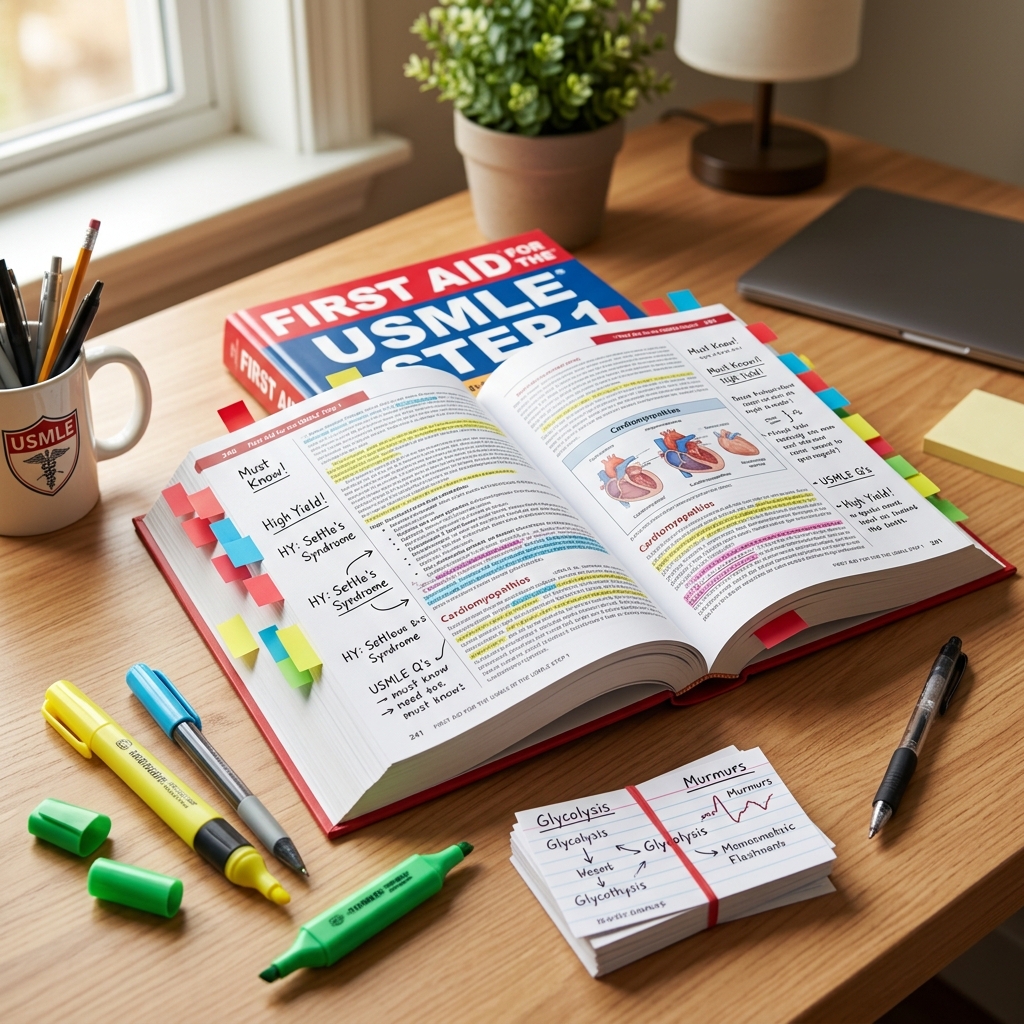
First Aid for the USMLE Step 1 is the most widely used review book in medical education. It's not a textbook — it's a condensed fact reference that covers every major concept tested on Step 1 in roughly 900 pages.
Almost every medical student in the US owns a copy. But owning it and using it effectively are different things. Here's how First Aid fits into your prep, the right way to annotate it, and where it falls short.
Key Takeaways
- First Aid is a reference and annotation tool, not a primary learning resource.
- Updated annually — the 2026 edition includes revised content for the new exam format.
- Price: ~$55 for the physical book, ~$40 for digital (Amazon, 2026).
- Best used alongside a QBank (UWorld) and video resources (Pathoma, Sketchy).
What First Aid Is (and Isn't)
First Aid is a condensed review of high-yield Step 1 facts organized by system and subject. It covers:
- Pathology, physiology, and pharmacology for each organ system
- Biochemistry pathways and molecular biology
- Microbiology and immunology
- Behavioral science and biostatistics
- Anatomy (with clinical correlations)
What it is: A one-stop reference for annotating notes from QBank review, lecture content, and practice exams. Think of it as your personal knowledge database.
What it isn't: A standalone learning resource. Reading First Aid cover to cover without context is passive studying and one of the most common prep mistakes. The facts are too dense to absorb without active learning from questions and videos.
How to Use First Aid Effectively
The Annotation Method
The highest-value use of First Aid is as a personalized annotation book:
- During QBank review: When you encounter a concept in UWorld that isn't in First Aid (or is explained better in UWorld), write it in the margins of the corresponding First Aid page.
- During Pathoma/Sketchy/B&B: Add notes and mnemonics from video resources to the relevant First Aid pages.
- During NBME review: Mark topics you missed on practice exams with stars or highlights.
By the end of dedicated study, your annotated First Aid becomes a personalized review book that contains everything you need to know — your UWorld insights, your video notes, and your weak-area flags — in one place.
When to Read It
- M1/M2: Skim relevant sections alongside your coursework. Don't try to memorize it.
- Pre-dedicated: Read the chapter that matches each organ system block you're studying.
- Dedicated study: Use it as a review companion — not your primary activity. After completing QBank blocks, spend 30–60 minutes reviewing annotated First Aid pages in the systems you just practiced.
- Last week: Flip through your most annotated sections as a final refresher.
First Aid vs Competitors
| Feature | First Aid | Pathoma | Boards & Beyond |
|---|---|---|---|
| Format | Reference book | Video + slim text | Video lectures |
| Coverage | Complete Step 1 blueprint | Pathology only | All subjects |
| Depth | Surface-level (facts) | Deep conceptual | Conceptual + clinical |
| Best for | Annotation, review | Learning pathology | Learning all subjects |
| Price | ~$55 | ~$99 | ~$299 |
First Aid and Pathoma complement each other perfectly. First Aid gives you the facts; Pathoma explains why those facts matter. Boards & Beyond fills a similar role but across all subjects.
Is the 2026 Edition Worth Buying?
If you already own the 2025 edition, the changes are incremental. The 2026 edition includes updates for the new 14-block exam format and minor content revisions, but the core material is 90%+ identical.
If you're starting your Step 1 prep fresh, buy the current edition from McGraw-Hill. The page numbers align with other resources (USMLE-Rx, AnKing Anki deck) designed around the latest edition.
Where First Aid Falls Short
Dense without context. A typical First Aid page lists 15–20 facts with minimal explanation. If you don't understand the underlying mechanism, those facts won't stick.
Errors and omissions. Despite annual updates, First Aid contains some outdated information and occasional errors. Cross-reference with your QBank explanations for accuracy.
Not good for pharmacology learning. First Aid's pharmacology tables are useful for review but terrible for initial learning. Use Sketchy Pharmacology or QBank explanations to learn drug mechanisms, then use First Aid tables for quick reference.
For a complete overview of all prep resources, see our Best USMLE Step 1 QBanks & Prep Courses comparison. For a detailed study schedule, read our USMLE Step 1 Study Plan.
Frequently Asked Questions
Should I read First Aid cover to cover?
No. Reading First Aid passively is inefficient. Use it as an annotation and reference tool alongside active learning from QBank questions and video resources.
When should I start using First Aid?
Start skimming relevant sections during M1/M2 coursework. Begin annotating seriously during M2 organ system blocks and throughout your dedicated study period.
Is the digital or physical version better?
Physical is better for annotation (margins, highlights, sticky tabs). Digital is better for searching. Many students own both.
How is First Aid different from USMLE-Rx?
USMLE-Rx is the QBank companion to First Aid — its questions are designed to test the same material. First Aid is the review book; USMLE-Rx is the practice question set built around it.
Can I pass Step 1 with just First Aid?
First Aid alone is not enough. It's a reference, not a teaching tool. You need active learning from a QBank (UWorld) and conceptual resources (Pathoma, Boards & Beyond) alongside First Aid. For a full overview of the exam itself, see our USMLE Step 1 Guide.
Related Posts
 mccqe
mccqeDHA Exam Guide: Dubai Health Authority License
Complete DHA exam preparation guide for 2026. Review Dubai Health Authority licensing, format details, eligibility, DataFlow verification, and pass rates.
Dr. Leila Haddad •
Feb 18, 2026
 mccqe
mccqeFree MCCQE Practice Questions: Sample MCQs
Access free MCCQE Part 1 practice questions with detailed explanations. Test your knowledge on cardiology, ethics, and public health in the new MCQ format.
Dr. Leila Haddad •
Feb 18, 2026